
Your voice is the rarest and most unique thing about you…and it’s what makes your memoir those things, too.
By Louisa Deasey
The Power of Memorable Memoir
I’ve been thinking about a writer’s ‘voice’, lately, what it is, and what a great power and privilege it is to imbue a reader’s imagination with your lines of thought, your perceptions and experiences. I want to share how to reveal your writing voice and the difference between memoirs with lines that linger (in a good way!) and writing that feels inauthentic and untrue because the voice is not there. Because when you have a strong writing voice, both reader AND author become entangled in an experience, a memory, and a perception, and this is the power of books and particularly, true stories like memoirs. They’re emotional, wise, funny, perceptive, deep. And above all else… true. They reveal a truth about the human experience that we can all relate to. And remember.
Memoir with lines that linger
“I long for the sun, but Australia is too high a price to pay for the old bugger…
But – ah- mes amis, the Spring!”

A Letter From Paris by Louisa Deasey
I read this letter 7 or 8 years ago, in a cold reading room in the National Library in Australia, typed from my father to a friend in Australia, from Paris, in 1954. I was researching what became A Letter From Paris. I was knee deep in the research process of wading through thousands of documents, trying to discover where he lived, and when. But more importantly, why.
Earlier in the letter he’d described the physical expense and difficulty of life in London and Paris as an Australian ex-pat. Pipes froze over in his Paris apartment. Cars (‘automobiles’) broke down and stalled, the days were short, and his lungs ached from the cold.
“But ah- mes amis, the Spring!”
The line has come to me over and over in the past few months during winter in Melbourne, and now it’s me thinking it. It’s me realising why you’d stay somewhere so difficult… because ah – mes amis – the Spring!!
And all voices, when they’re strong, convey a deeper emotional resonance. Lines that stay in your head for years convey some relatable aspect to the choices we face as humans, the way the smallest things can get to you (or save you)… and it’s why writers working on memoir (personal story) need to get ready to tell the truth, the whole truth, and nothing but the truth on the page.
Memoir is relatable when the voice is strong and true
Because that line, and every line from song or page that’s lingered for years in my consciousness, has relayed a connecting aspect to me, something so relatable, so true and honest about life and the questions and perceptions I’ve struggled with in my own life. The Spring line returns over and over as I’ve been deliberating choices, here or there, this or that, how my move back to Melbourne from my country mountain idyll when my friend was dying was perhaps a fateful mistake…ah but, mesa mis, the Spring! Because there’s roses blooming the size of my hand and the jasmine scent is so heady you forget the cars and noise and the sun and the warm and suddenly Melbourne is Paris in first bloom of cherry blossoms and winter, like pain that had you weeping in agony for nights on end, is immediately forgotten.
Ah but, mes amis, the Spring…
Do you have lines that linger in your memory for years after you’ve read a book, a passage, a page? A few students in a cluster asked me how to define ‘voice’ in a memoir so I’ve been considering what it is, and how to explain it.
Because for memoir, as for all creative nonfiction, the voice of the narrator is absolutely crucial.
What is your writing voice and how do you describe it? One of the reviews of A Letter From Paris described it as “raw, intimate, and unpretentious”. Reviews are a great way to find the description of voice in a memoir, and if you’re reading comparative titles to your own, it will clarify what you value in personal writing, too.
You’ll find that you ENJOY reading memoirs with a voice that aligns with many of your own values.
TIP: In reviews of memoirs you love to read, take a note of how the voice is described.
The power and privilege of sharing your (authentic) voice on the page:
If you’re lucky, some readers will ‘get’ your voice in their head and some of your lines, which are really your thoughts and perceptions, will linger with them long after they’ve finished the last page.
If all creative work comes from a higher consciousness, and writing is just ‘tapping in’ to that consciousness, then you can find the voice of your all-knowing, all-seeing Self when you write, through letting the thoughts and feelings flow on the page without fear.
It’s resistance, judgement and ‘mind chatter’ that keeps us over explaining rather than just pouring the truth down, letting it be, taking the ‘human’ out of the story and letting our Spirit flow through the page. But that Spiritual truth, the truth of human experience: love, longing, joy, grief, appreciation, split second choices, timelines that shift and change depending which road we take, which bus we catch, which move we make…that makes a deep and lingering memoir. One that reveals a universal truth of human experience. How fragile and vulnerable, how Divine and multi-dimensional… and how eternal our consciousness really is, when we turn this Higher mind into art, whether that’s literature, music, movie or something else.
It’s a privilege and a great responsibility, to have readers ‘in your head’, sharing that feeling, that sense, able to picture and smell and feel what you went through… to watch the ‘movie’ essentially, of a snapshot of your life.
And it’s also incredibly vulnerable, on your part.
You’re literally inviting a reader into your heart, to view the world as you did, and do. To see and sense as you do. You’re inviting them to share your state of consciousness: angry, scared, naïve, living, grateful. Alive for a limited time.
And it’s this vulnerability that blocks so many writers, or keeps them hiding their truth or holding it at arm’s length, locked away behind logical descriptions of events and the type of writing that would work better in a legal document than a compelling narrative.
Having a strong and authentic voice, in a memoir, is crucial.
Memoirs with lines that linger and a strong voice
It’s not just lines from my dad’s letters and memoirs that I spontaneously recall.
Two memoirs I explore inside The Art of Memoir (because I love them!) have lines that have stayed with me years after finishing.

Wild by Cheryl Strayed has a strong and authentic writing voice with lines that have stayed with me for years…
There’s lines from WILD, by Cheryl Strayed, that still come to me 14 years after I read her memoir when it was first published in 2012.
“How wild it was, to let it be…”
Is one of them, and it’s the very last line in the book. It’s had me in tears quite a few times, because when you get to that line, having been immersed in her inner narrative, her transformation from ‘lost’ to ‘found’ on the Pacific Crest Trail… you’ve felt the terror and grief and joy and relief of her human journey, the epic hero’s journey we’re all on, to get to a place of perceiving where we can just ‘let it be’.
Her voice, my voice, the objective ‘truth’ speaker, the all-knowing narrator… I share her relief and realisation of truth, when i think that line. We intersect and interweave when an author has such a strong and authentic writing voice. We think their thoughts. We see through their eyes. We are immersed in their consciousness, for a time.
And this is the thing with a strong and powerful ‘writing voice’ for memoir, it’s YOU. And you’re imparting the reader with a higher knowledge, in many ways. This is what I mean by power and responsibility.
This is why memoir MUST be empathic, objective, to the truth of life and the human experience, more than anything. You don’t want to leave the reader hopeless, angry, in despair! This is also why the PROCESS of writing it must transform YOU from that naive perspective on the experience to the all-knowing wisdom that comes from reflection and a deep understanding that nothing, and no-one, in your life, was an accident.
This is the deeply Spiritual work of writing memoir for mass publication, and the responsibility of it, too.
And it means YOU must be at a point where you’ve consciously revealed (or remembered) a sense of ‘meaning’ to the challenges and events in your story which come from your Higher Self, not the primal self blinded by chemical reactions of fear, anger, hurt, and justification.
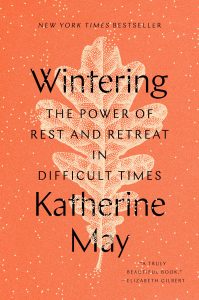
Wintering by Katherine May
Another line that lingers from a memoir is from Katherine May’s nature memoir, ‘Wintering’.
It’s midway or two thirds of the way into the narrative, when she’s visiting the Sámi in Norway, while pregnant. She’d been describing the Sámi beliefs, traditions and practises that illustrate their sacred bond with reindeer. It’s a beautiful chapter in a book which illustrates the anthropomorphic interconnection between humans and animal beings in nature, particularly connected to Winter. She weaves seamlessly from practical and biological descriptions of certain behaviours and biological responses, to her own experiences. And that particular chapter has one of the biggest turning points in the memoir, when her host, Trine, who has been calling her Mama Reindeer, offers her a second bowl of soup, sensing her fragility.
“Because, Mama Reindeer you don’t have your antlers on.”
The weaving of animal, human, family, community, and the sense of care… is how she pulls you into her perceptions, that subtle and dramatic shift of awareness. Where she had more compassion for herself, and finally seemed to let go of some of the ‘inhumane’ thought programs we’ve been indoctrinated to believe, about continuing to work, push and strive through the most challenging seasons of our lives.
This sense you get, in a memoir written with a vulnerable and powerful voice, of the truth of the narrator’s shift in perception, is what you’re aiming for. And you can only get there through observing your life through an objective lense. Sensing patterns, noticing symbols. Reflecting on the universal truth that everything and everyone around you is an aspect of yourself you have yet to recover.
So what IS writing voice, exactly?
- Voice is that part of a memoir that is not the story itself, but it’s your thoughts, your way of thinking.
- Your voice shows your character, your feelings, your values, and what you struggle with… in a memoir you will have a change in tone and perception from the start to finish of the story, because your perceptions and beliefs will change. (And if they don’t? There is no story).
- Your voice and tone is not something anyone can ever replicate, because it’s your conscious mind and your unconscious patterns and beliefs, playing out and always changing and evolving
It’s impossible to give instructions on how to replicate a sentence with a strong voice, (which is exactly why AI writing tools can never replace your pen, paper or hands on the keyboard)…but you can tell when you read writing that is inauthentic, dull, repetitive and has no change. It’s like a piece of music with only one line repeating.
So while I can’t tell you what YOUR voice sounds like (that’s the whole process of discovery that comes from writing), I can tell you exactly how to REVEAL your voice. The daily practise of writing in the Art of Memoir is like polishing a piece of marble until it’s visible, clear and free.
And this process of revelation brings forth the honest you.
The real you. The one who doesn’t take fifteen pages to ‘warm up the audience’ or ‘get to the truth of the matter’. The one who writes a query with the hook in the first line, not two paragraphs spent ‘clearing their throat’ before you feel you’re allowed to state what’s actually going on in this story.
And that daily practise is really simple: it’s to let yourself share the truth on the page. Let yourself pay attention. Let yourself reflect on what matters, and why it matters, and who and what you value and remember and love and run away from…
The Daily Practise of Honouring your Thoughts & Perceptions through writing
Everything I teach inside the Art of Memoir is about helping you find the truth of who you are and then expressing that from a place of freedom, confidence, trust, and deep inner security.
It’s why I have a bit of a controversial (😂!) 30 day process I get everyone to go through at the beginning of the programme, where you simply write in a journal (by hand) every day in a guided reflection practise, to give yourself the consistency and the time and attention that ‘trains’ you to find yourself interesting. Find your thoughts interesting. Pay attention to yourself. Look INWARDS, for the first part of every day. Put yourself first. Give yourself time and space. Slow down, breathe, release, notice things. How revolutionary! (And controversial 😂).
Because I want you to see how to disentangle from the programs of the world and plug back in to YOUR state of consciousness. YOUR truth. YOUR voice. And you can only do this when you’re not repeating and re-iterating lines from judgemental outsiders or family opinions or things you picked up somewhere without even meaning to, regurgitating beliefs you don’t even hold…
You’ve got to come back to the truth of who YOU are, and trust yourself, to have a strong and powerful voice. But it’s the most empowering thing you could do, because this is your life, and your story, and nobody else can tell you how it felt and what it meant and why it led to this and that and what that showed you and why that matters so much that you want to share it with the world. This is not something anyone can ‘tell’ you how to do. It’s not something you can plug into a chat bot, your Spirit needs you to listen, above all. Listen and reflect. That’s Higher Consciousness. That’s the only way you can hear it!
The Memoir Journaling process is a 30 day practise I insist upon before jumping into the drafting process because you must consistently be in that awareness practise of noticing and listening to your Self on the page. And that only comes from consistently giving yourself time and attention.
That’s where the voice of your Higher Self is waiting.
There are no random events, only patterns unrecognised.
A strong voice in Memoir
I believe a strong memoir writing voice and the Higher Self are interconnected:
A strong voice isn’t one that bludgeons you with awful material, details and drama. That voice squeaks and strains, because it’s never given itself a chance to be heard.
A strong voice is one that knows itself and trusts itself. It doesn’t need to prove any points. A strong voice knows its power.
And that’s the power to linger in someone’s mind, for years after they’ve finished immersing themselves in your experience, relating, empathising, and hopefully gleaning and gaining a fresh insight and perspective on how to live a life.
It’s a great honour to have someone read your book when it’s a memoir, because it’s not just a story you lived, it’s also how you think.
Your voice reveals the state of consciousness you were in at the start of the story, and the growth and change in your conscioiusness by the end of the experience or focal point. And the only way you can write so truthfully and honestly (as YOU, with YOUR voice, not what you think you need to write or should write or need to explain to people) is if you set up the conditions to do it in safety and solitude, until you’ve processed and unwrapped the experience on your own.
This is one of many reasons I believe memoir writing should be done in safety and solitude, not in workshops and critique circles. It’s a personal act of courage, and like Katherine May, you’re pregnant with new life and need to be treated with extra care until you have your antlers!
And of course, your voice will change throughout the story you tell on the pages of your memoir, but it has to be honest, and you need to share your heart and feelings and perceptions AS they changed. This takes detail, courage and the art of noticing yourself.
We show character change and evolution in our choices, shifts in perception and behaviour. And by coming to a point of greater compassion and awareness of ourselves, and others, by the end of the story.
The journaling process I get every writer in The Art of Memoir to do at the beginning matters, because when you write every day like this, you start to notice repeating thoughts, lines and beliefs that are and aren’t your own.
And that’s the unconscious (or the superconscious!), banging at the door, waiting to be let out.
Unlocking your voice through making the subsconscious, conscious
“Until you make the unconscious conscious, it will direct your life and you will call it fate.”
C.G. Jung
What lines, wishes, hopes, fears, visions, dreams, come up for you, again and again and again?

When I was writing A Letter From Paris, I had a recurring dream that I’d had quite a few times over the years, but never with such intensity, about being unable to speak.
The dream had a few different versions: I was cornered or stood over by a bully, people were around but I couldn’t let them know I needed help. I couldn’t speak. I had no voice. My throat was silenced. I was silenced. But it wasn’t from anything someone else did, it was my own throat (my own body) betraying me. Afraid.
When I’d finished revising the book, and finally saw the printed copy, over a year later, I never had that dream again.
There’s a great karmic turning that happens when you reclaim your own story and liberate yourself from the ‘voices’ and judgements you’ve embedded and taken on since childhood.
But the way you re-program the story is to tell it, in your own words. To give yourself a chance to speak on the page. Because the page won’t silence you or judge you, and it cannot manipulate you. If you weren’t interested in the truth, you wouldn’t be interested in writing your memoir. But you are, and the page will reflect that back to you.
Because it’s blank. It’s neutral. It’s a mirror you get to hold up and a torch you can shine on the gold hiding in symbols and unrecognised patterns in your subconscious.
And it’s how you find your voice.
So by writing truthfully, paying attention, giving your Higher Self and your human self the chance to reveal themselves…you strengthen it.
And this is not something AI can ever replicate.
Because it’s what makes you human and Divine at the same time.
To the joy of authentic creative expression,
Louisa
You May Also Like…


Louisa, this is such good teaching on voice. There’s a line from “Eat Love Pray” when Elizabeth Gilbert writes about her collapsing marriage. “I had actively participated in every aspect of the life I created. So why didn’t I recognize myself in it.’ That might be a slight paraphrase but it’s pretty close. It always stuck with me because of its truth! I, too, had been actively participating in the life I had created which I was not always happy with. Gave me much pause to consider my part. Writers who share truth invite their readers to feel less alone in the human experience. Is that not why writers writer and readers read?
Thanks for reading and sharing, Donna!
I love that you remember that line because it resonated so much with you…There are parts of WILD I remember because i had to just pause and sit there, taking it in. A scene with the horse, a scene with her dad, a scene about her mum… but back to the EPL line you recall: It really DOES expose a universal truth: we are all active creators of the life we’re in, whether we like it or not! In memoir, we use ourselves as the example we parade on stageview for the reader to ‘get’ the lesson… which is pretty brave, if you ask me!
Absolutely loved this blog. Now that I am in the final revision stage of my memoir I see my voice. I wasn’t sure but after reading this, I am now sure and ready to enhance my voice through being so transparent.
Fantastic, thank you for sharing! And yes, your voice is strong!